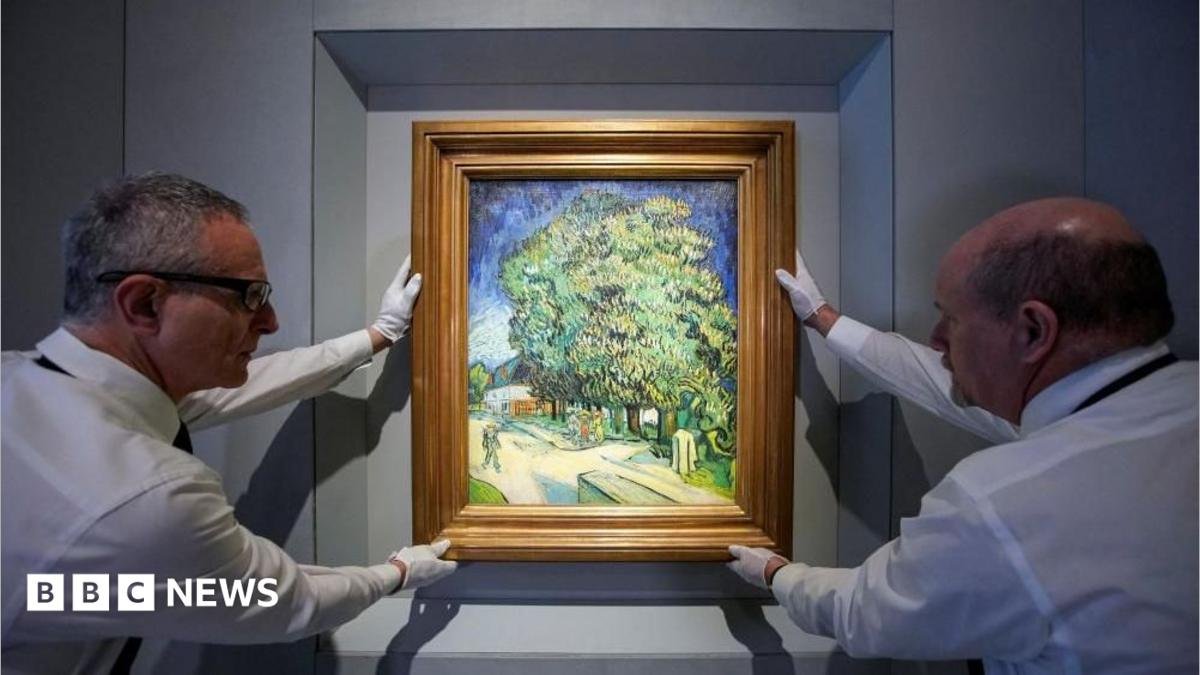
A highly anticipated auction of a Vincent van Gogh painting valued at $180 million has been thrown into uncertainty after heirs of its former German owners claimed the work may have been sold under duress during the Nazis' rise to power.
The painting, Châtaigniers en Fleurs (Blossoming Chestnut Trees), is scheduled to go under the hammer at Sotheby's in New York on Wednesday. But representatives of the Fischer family, who owned the artwork in the early 20th century, have raised concerns that its sale in the 1930s was not voluntary.
Sotheby's said it has conducted extensive research into the painting's ownership history but has not found evidence to support the duress claim. Still, the auction house has pledged to engage with the family to find a resolution.
Auction house responds
In a statement to the BBC, Sotheby's said: "Sotheby's takes provenance and restitution matters extremely seriously and has undertaken extensive research into the ownership history of Châtaigniers en fleurs. We are aware of the concerns recently raised by representatives of the Fischer heirs and have been in dialogue with them regarding the painting's history."
The statement continued: "While our research to date has not established that the painting was sold under duress, we recognize the importance of engaging thoughtfully and constructively with the family and are committed to working toward a mutually satisfactory resolution."
The painting is being offered as part of the Blaquier-Arrieta Collection, and Sotheby's website details its provenance, tracing its ownership back to 1890.
Ownership history
According to Sotheby's, Samuel Fischer, a renowned German publisher, acquired the painting in 1909. It remained in his family after his death in 1934. The auction house says the work was deposited with Paul Cassirer in Amsterdam in 1932 or 1933, before passing to Henriette and Marcel Kapferer in Paris in 1936. It has since had four other owners.
However, lawyers for the Fischer heirs argue that the sale in Amsterdam before World War II was a result of financial pressures faced by the family's publishing business under the Nazi regime. The New York Times reported that a lawyer representing the family has written to Sotheby's outlining these concerns.
The BBC has reached out to the lawyer for further comment.
Restitution concerns
The dispute highlights ongoing concerns about the provenance of artworks sold during the Nazi era, when many Jewish families were forced to sell valuable possessions under duress. Auction houses have faced increasing scrutiny over such sales, and cases like this often lead to complex legal and ethical negotiations.
Sotheby's has not indicated whether the auction will proceed as planned, but its commitment to dialogue suggests a potential delay or settlement. The outcome could have implications for the sale of other artworks with similar histories.
The painting, a vibrant depiction of chestnut trees in bloom, is considered a significant work from Van Gogh's later period. Its estimated price tag of $180 million places it among the most valuable artworks ever to come to auction.
As the art world watches closely, the Fischer family's claim serves as a reminder of the lingering shadows of history that can affect even the most celebrated masterpieces.