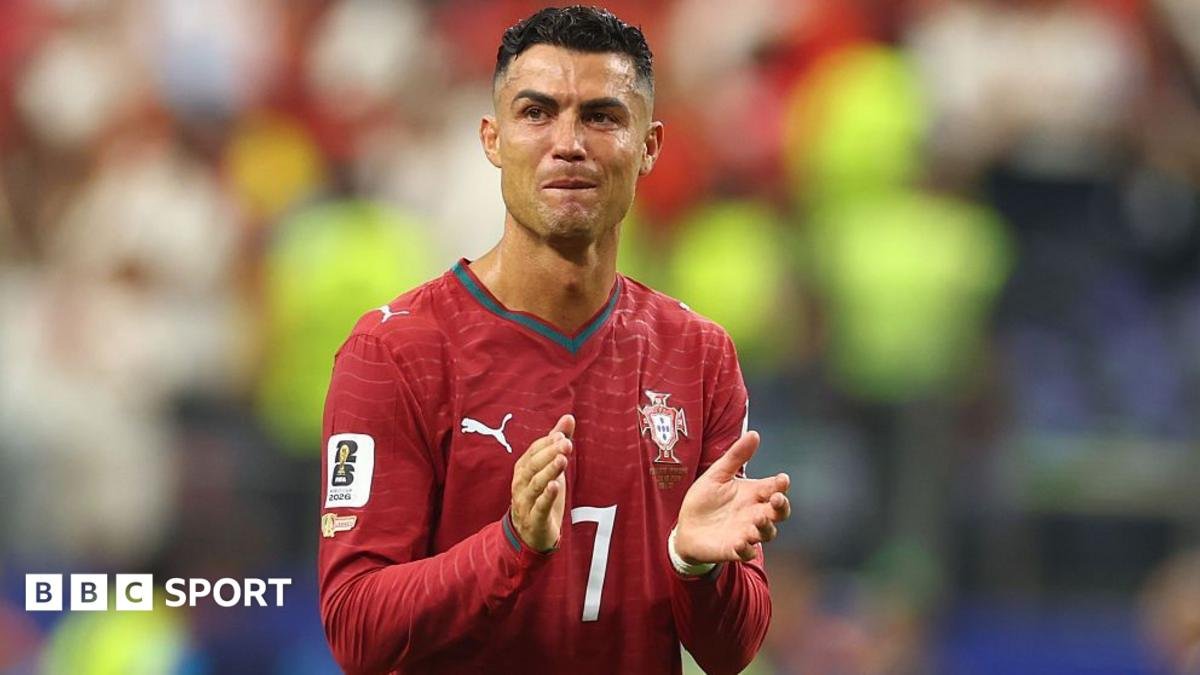
Cristiano Ronaldo's retirement from international football was never going to be straightforward. The 41-year-old, who has defined an era for Portugal, announced his decision after 23 years, but the manner of his departure has left a sour taste. A fallout with coach Jorge Jesus led to a 30-day sanction and a fine of 255 euros for leaving the training camp without permission. Jesus had kept him on the bench for one match and indicated he would not start him in the next, prompting Ronaldo to go home.
A Glittering Career
Ronaldo's last appearance came on 24 September against Wales. He ends his international career with a staggering 146 goals in 234 games, a record that may never be broken. A message circulated in Portugal thanking him for everything, calling him a global ambassador and an inspiration to millions. Yet the way it ended leaves a bitter taste, especially for a player who has always demanded to be the main man.
Was he going to be named in the next squad? Possibly, as Jesus said the door was open and the decision was Ronaldo's. But it was clear he was no longer an automatic starter, and Cristiano has never handled that well. So is this another hissy fit? Partly, yes. He reacted the way he always has when a coach questions his place. But that label hides how much he adapted over the years.
Such a pattern appears with almost every man who sat on the Portuguese bench. There were clashes, but also communion with managers and team-mates that help explain this ending.
From Raw Talent to Global Icon
When a young Ronaldo first joined the squad, he arrived at camp with his baseball cap on backwards, enormous sunglasses and headphones turned up so loud they could be heard from a distance. He would not take the cap off to eat among veterans like Luis Figo and Rui Costa. Luiz Felipe Scolari saw an extraordinary player who was immature and obsessed with showing off. He reprimanded him in public, then told him privately that if he changed his attitude, he would one day captain Portugal.
The first great disappointment came early, and it came at home. At 19, Ronaldo played in the final of Euro 2004 at the Estadio da Luz in Lisbon, in front of a country that had convinced itself the trophy was already on its way. A single headed goal by Angelos Charisteas was enough for unfancied Greece to win it by surprise. When the final whistle went, Ronaldo could not hold back the tears, and the image of the teenager crying on his own pitch travelled everywhere. It was a painful way to learn what a final costs, and it left him with a hunger that never really went away.
Figo owned the number 7 at the time, so Ronaldo had to have 17. Figo helped him settle but had no intention of making it easy. When he left the national team in 2006, the shirt and the team became Ronaldo's.
In September 2005, before a qualifier in Russia, Scolari and Figo went to his room to tell him his father had died. Scolari offered to send him home. Ronaldo chose to play, asked his team-mates to behave as normal, and spent time in the dressing room doing ball tricks. That was his way to cope with the expected but still hugely hurtful passing of his alcoholic dad. He later called Scolari "father". That way the national team had become the place that held him together.
Things went sour with Carlos Queiroz. After the 2010 World Cup exit against Spain, asked to explain a poor performance, Ronaldo told journalists to ask the coach. His influence in the camp had grown so large it changed routines and habits, which explains why the coach felt undermined.
The sociologist Joao Nuno Coelho offers the best lens on how Portugal sees him. In his analysis, the national team became a representation of Portuguese identity and of the country's need to be seen internationally. In years of economic hardship and a crisis of confidence, a team that won admiration abroad was important beyond football. Ronaldo stood at the centre of that need and created contradictory feelings. Some Portuguese questioned his individualism and his ego, and not everyone saw themselves in his personality. Coelho explains criticising him became more difficult as time went by. The country wanted to be proud of him and sometimes felt uneasy at the same time.
The former international Jorge Andrade told me some supporters preferred figures like Figo, Eusebio, Paulo Futre or Rui Costa. Even so, Portugal was proud to have him. And with the titles, the doubts eased.
The Leader Emerges
Under Fernando Santos in 2016, he changed. He accepted playing as a centre forward next to Nani - he had never taken a coach's instructions so naturally. After the opening draw with Iceland, he told Nani in private that he trusted Santos, and the dressing room began to see a real captain. After missing a penalty against Austria, he barely slept. Santos woke up and found him already awake. At the training camp in Marcoussis, he took a fan's megaphone and told supporters Portugal had won nothing yet. He was enjoying the leadership role.
In the final in Paris, he left the pitch in tears, injured. He had not had the best tournament, with a muscle complaint that did not let him perform at his best. Nani took the armband. At half-time Ronaldo pulled himself together to encourage his team-mates, and before extra time, still limping, he told Eder he would score. But the old instinct never fully disappeared. During extra-time, Ronaldo stood in the technical area giving orders until the fourth official sent him back. Other coaches I consulted found it excessive. His greatest strength, the need to influence every result, also made limits hard to accept.
When he debuted in 2003, Portugal was still searching for its first major title. Some players mark an era, and others change a national team for good. He belongs to the second group. That night in July 2016 gave Portugal its first European Championship. Three years later he scored a hat-trick against Switzerland to put them into the first Nations League final, which Portugal won. In 2025 he lifted a second Nations League at an age when most players have retired. No one has scored more goals for a national side, and no one has pulled on the Portugal shirt more times.
Under his influence, Portugal stopped being a gifted team and became one that arrives at every tournament expecting to contend, while a whole generation of players came through a dressing room where he decided what the standard was. Coelho's point holds here as well: a small country found a way to be noticed, and for two decades he was its face.
After 2016 the question around him changed. Fewer asked whether he was selfish, and more asked whether Portugal depended on him too much. In the World Cup in 2018, he scored three against Spain, including a free-kick after 45 attempts in major tournaments, and the team still went out to Uruguay. After a difficult 2026 World Cup, much was made of him still starting up front when in fact statistically that was his best period. Under Roberto Martinez, with 28 goals in 37 games, 0.756 per match, improves the 0.624 with Santos.
The federation has announced a special tribute to honour his contribution, and that is necessary as the exit has not left fans room for a celebration they want to be part of. Not only they grew up with him, he took them to places they had not yet been.