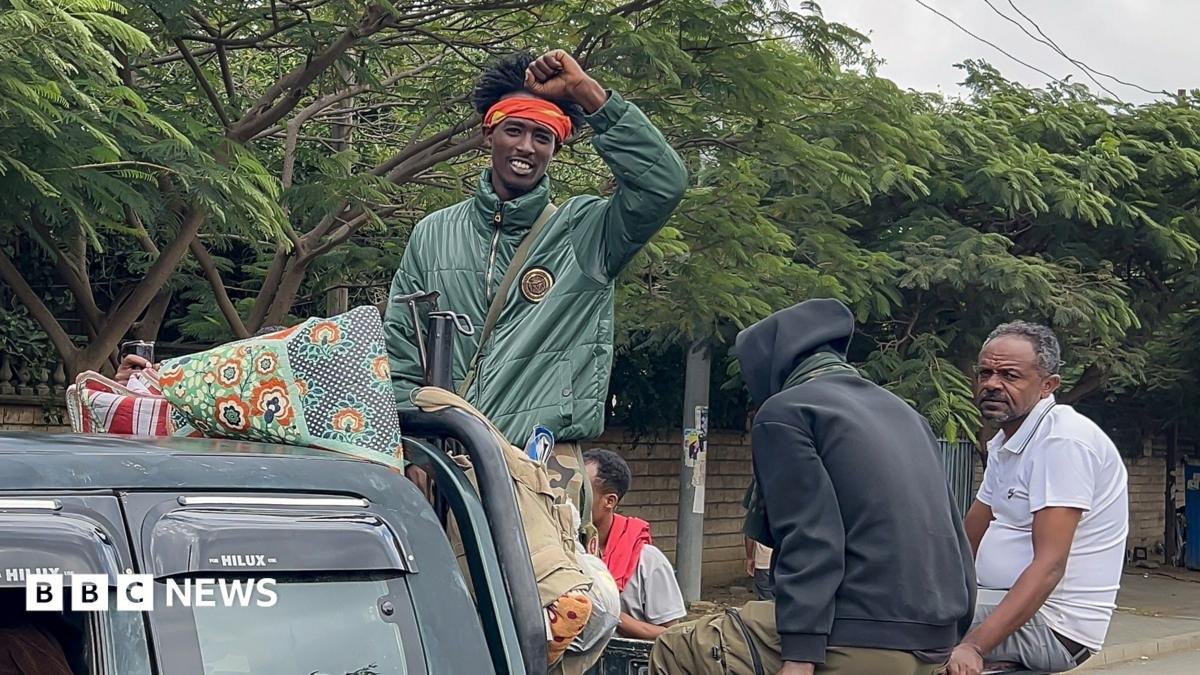
In the battle-scarred capital of Ethiopia's northern Tigray region, Mekelle, the scars of war are not just visible on the buildings but etched into the daily lives of its residents. Firut Me'ar, a single mother who runs a hair salon, speaks with a tremor in her voice about the struggle to survive. "People can't prioritise beauty over daily basic needs," she says. "For many, self-care is a luxury when they can't feed their kids."
A Fragile Calm
The city is now under the control of the national army, but life is far from normal. "Things are better than during the war, but people still have no money, no morale. Business is almost non-existent," Firut adds. Above all, there is uncertainty about what the future holds.
Fighting erupted in late September between the Tigray People's Liberation Front (TPLF) and the national army, reigniting a conflict that had officially ended in 2022. Within two weeks, federal forces marched into Mekelle, and the TPLF made what it called a "strategic withdrawal" from the city and other main towns. Hundreds are reported to have died, including dozens killed by drone strikes and air raids.
Ethiopian government officials argue that the war is effectively over and that the remaining task is to clear Tigray of TPLF elements. Getachew Reda, a senior TPLF official who switched sides and now advises the prime minister, declared that the war had ended and that stabilising the region is the immediate priority.
Why the TPLF's Defeat Was Rapid
Analysts point to multiple reasons for the TPLF's swift defeat. Cameroon Hudson, a consultant on African peace and security, says the group has lost popular support, is fragmented, and lacks the advanced military technology to match the Ethiopian National Defence Forces (ENDF). "It has lost many of its generals, strategic thinkers, finest diplomats and fighters, either through defections or arrests," he says.
Abraha Hailezgi, a scholar at Mekelle University, adds that the TPLF army lacks a clear political vision and has become associated with coercion and abuses, leading many to view it as an adversary rather than a force acting on their behalf.
But TPLF spokesperson Mikael Asgedom denies any defeat. Speaking by telephone from an undisclosed location, he describes the withdrawal as a deliberate tactical and strategic retreat. "This is not a defeat," he insists. "We intentionally allowed the ENDF to advance deeper into the heartland of Tigray, where it can be isolated and confronted on favourable terrain." He claims the TPLF is preparing for a major counteroffensive and has already launched attacks against Ethiopian forces in several locations.
Fighting Continues
While phone lines and internet have been restored, verified information remains scarce. Residents in different parts of Tigray tell the BBC that fighting continues in central, northern and north-western areas, with heavy artillery and drone strikes. Near Sheraro, close to the Eritrean border, eyewitnesses report heavy fighting involving artillery and ground forces.
Memories of the devastating 2020-2022 war, which claimed hundreds of thousands of lives and saw widespread human rights abuses, are still raw. The reappearance of Eritrean troops, accused of some of the worst atrocities in the previous conflict, has reopened old wounds and instilled fear among residents.
A Prolonged War?
Security analysts are divided on what lies ahead. Yared Tibebu, a well-known Ethiopian commentator based in the US, believes the TPLF is preparing for a lengthy conflict. "I see a situation in which there could be a prolonged war in Tigray," he says, pointing to the TPLF's history of protracted armed struggle. However, he acknowledges that internal divisions may delay any offensive.
Hudson, on the other hand, rejects the idea of a prolonged war but agrees that peace may remain elusive. "The TPLF may continue a low-level insurgency and guerrilla campaign, but that is not war," he says. He argues that the group no longer has the size, strength or military capability to confront federal forces effectively.
Yared, however, points to the TPLF's resilience and its alliance with other rebel groups. In September, seven Ethiopian rebel groups led by the TPLF formed the Alliance for Survival, aimed at removing Prime Minister Abiy Ahmed's government. Yared believes this could give the TPLF the strength to keep fighting, citing the organisational capacity of the TPLF's military wing and the estimated 70,000 to 80,000 fighters of the Fano militia.
Hudson dismisses this, insisting that the alliance is unlikely to alter the balance of power. "The ethnic militias have not demonstrated the capacity to pose a serious threat to federal forces," he says.
The Path to True Peace
Abraha from Mekelle University argues that the conflict will only truly be over if the federal government addresses Tigray's feeling of economic and political marginalisation. Many Tigrayan elites remain wary of Addis Ababa's intentions, questioning whether the government is genuinely seeking to solve the region's problems or exploiting its weakness.
For ordinary people like Firut, the priority is simple: peace. "Peace seems slow in coming. Most people are tired of politics. Whatever happens, we only want peace and a chance to rebuild our lives," she says.