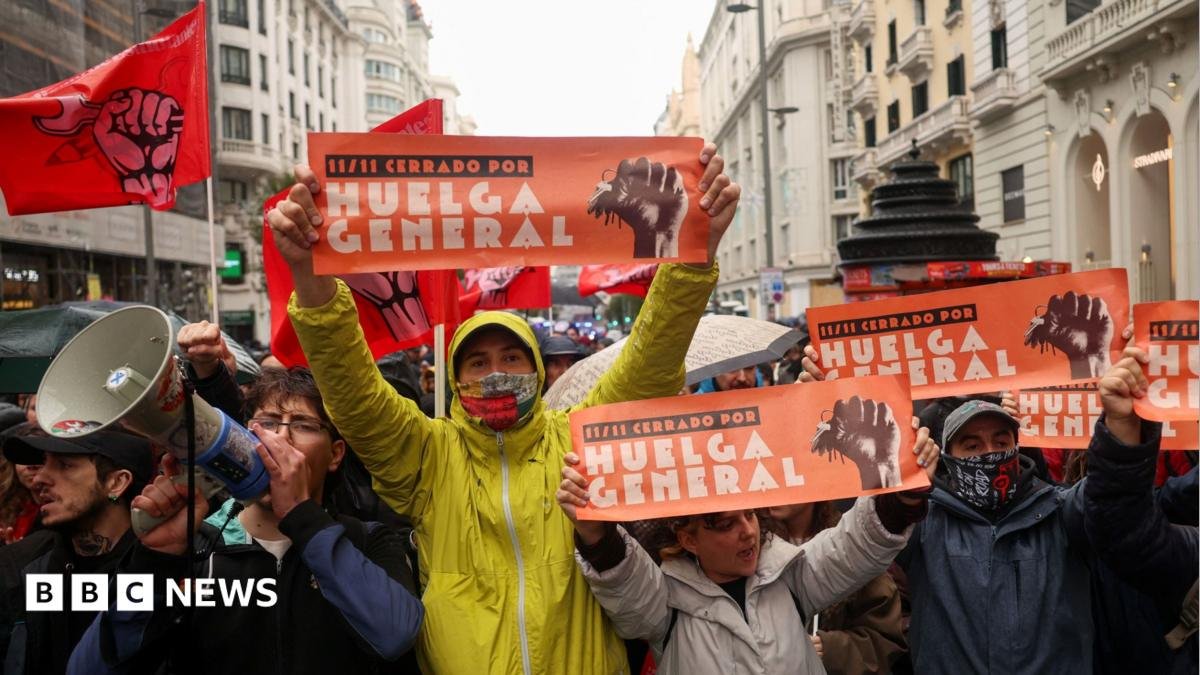
Spain is experiencing its first general strike in 14 years, with transport and public services severely disrupted as unions protest against soaring housing costs and the high cost of living. The strike, called by the main unions UGT and CC OO, comes just over two weeks before national elections on 29 November.
Widespread Disruption
Major industrial hubs such as Madrid and Catalonia saw traffic halted on several main roads, and the interior ministry reported dozens of arrests related to various incidents. Estate agencies also reported attacks on their offices. Union leaders Pepe Álvarez of UGT and Unai Sordo of CC OO hailed the strike as a success, citing "massive" and "very significant" participation. However, the Spanish Confederation of Business Organisations described turnout as "low and uneven" across different areas and sectors.
Housing Crisis at the Forefront
The strike was triggered by widespread outrage over affordable housing and rising living costs, highlighted by the eviction of 87-year-old Maricarmen Abascal from her Madrid flat of seven decades. She died in hospital weeks later. Rental prices in the capital have skyrocketed, with a 50-square-meter apartment averaging €1,170 per month, nearly half the average gross monthly salary of about €2,460. This far exceeds the 30% affordability threshold recommended by experts.
Political Divide
Prime Minister Pedro Sánchez and his allies have supported the strike, while opposition leaders have criticized it. Sánchez called snap elections last month after parliament rejected his housing reform plan. He praised strikers on social media, writing: "Your eight-hour day. Your pension. Your public healthcare… These were collective conquests." The conservative People's Party (PP) accused the government of exploiting the strike for electoral gain. PP leader Alberto Núñez Feijóo called the strike "nonsense" and labeled unions "mafia" and "trash." Party spokesman Miguel Tellado accused the government of warning voters against a right-wing government.
Voices from the Strike
Gonzalo Álvarez, 27, a sales worker volunteering for a housing union, joined picket lines in central Madrid. He knew Abascal and was deeply upset by her treatment. Álvarez spends half his salary on rent for a one-bedroom flat he shares with his girlfriend. "It's absolutely crazy… with the food, with the electricity, with the water, with gas," he said, adding that buying a home is "completely impossible" with current salaries and prices.
Business leaders criticized the strike. Miguel Garrido, vice-president of the CEOE, argued that businesses have little to do with housing prices and that the strike is politically motivated, closely linked to the early elections.
Demonstrations are planned in major cities later on Wednesday, and the scale of support will be seen as an indicator of public discontent ahead of the election. Another gauge is electricity demand, which fell by 7.5% in the early hours of Wednesday, compared to over 15% during the last general strike 14 years ago.