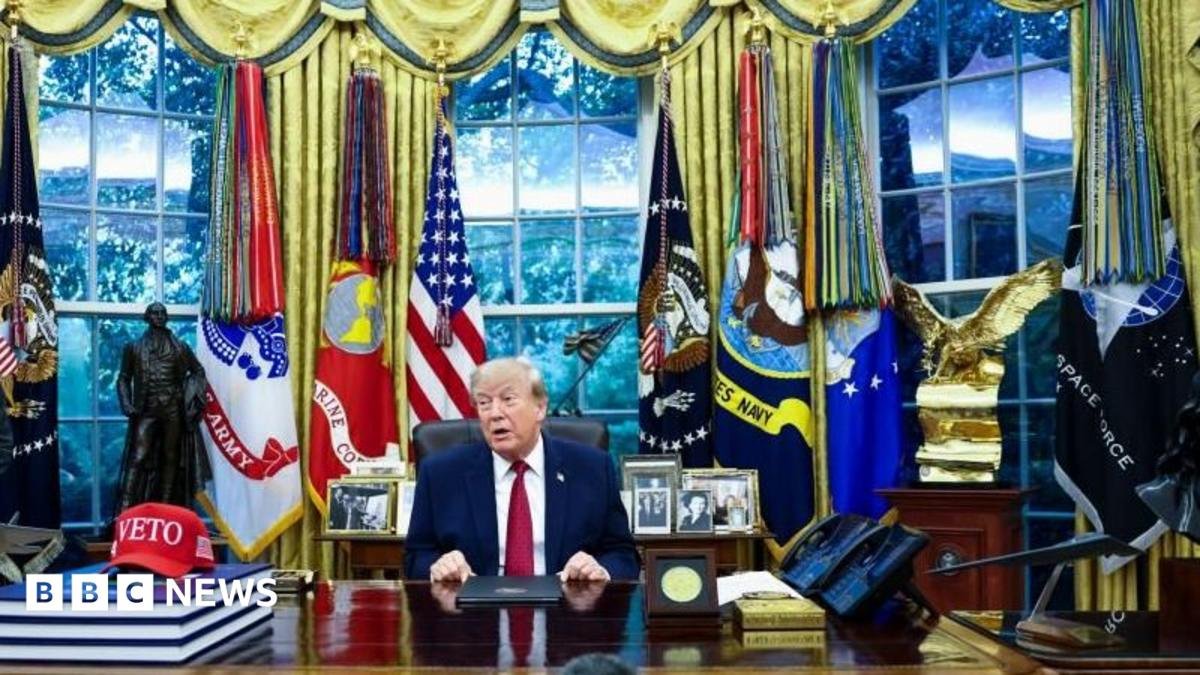
US President Donald Trump has signed an executive order aimed at preventing future presidents from making certain changes to the White House Oval Office. The order declares the Oval Office and some surrounding rooms as a national monument, a designation typically used to protect sites of historic or natural significance.
A Symbol of the Country
Trump, a former real estate developer, has left his mark on the office during his second term, notably by adding gold features to its walls. "So we're making it a national monument, and it will not be allowed to be touched by anybody, destroyed, ripped down by stupid people, in order to build something in a slightly different shape," Trump told reporters on Thursday. He added, "We like the Oval Office, and it's a symbol like the White House itself. It's a symbol of our country and the greatness of our country."
The executive order states that it does not restrict the president's authority to redecorate, select furnishings, or make ordinary operational and security modifications that do not substantially impair the monument's historic structure or architectural character.
Presidential Powers and Legal Questions
American presidents have the power to create national monuments, which are similar to national parks. Trump's order calls on the National Park Service to maintain the office in a manner that protects its historic character, architectural integrity, and association with the presidency.
The entire White House building is already designated as a National Historic Landmark, intended to prevent sudden changes. Trump's proclamation notes this existing protection but argues that the Oval Office merits specific recognition and protective management as a discrete historic structure of national significance.
Congress has carved out an exemption to the National Historic Preservation Act to allow presidents to make needed changes. The current Oval Office has existed since the early 1930s, after its conception by President Franklin D. Roosevelt.
Criticism from Preservationists
Greg Werkheiser, from the law firm Cultural Heritage Partners, which specialises in historic preservation, says that temporary alterations like furniture and decor are completely up to the president's discretion. "As long as they're not damaging the permanent art and architecture, they can generally do whatever they want," he told BBC News.
However, Werkheiser argues that the Trump administration has shown extreme disregard for other historic sites in Washington and has attempted to undermine preservation laws through lawsuits. He points to Trump's efforts to renovate the Kennedy Center, build a new triumphal arch, and paint the granite exterior of the historic executive office building. Werkheiser's firm has filed lawsuits to block two of these projects.
"The hypocrisy is that on the one hand he's talking about the importance of preserving the Oval Office - which is legally meaningless because he can't do it - and on the other hand he is absolutely taking an axe to the law that allows us to preserve other historic sites," Werkheiser said.
In October, Trump suggested in an interview with Time magazine that the Oval Office would need to be torn down due to security concerns from the US Secret Service. "I said, 'My ass, you can't build a new one. This is a special place,'" Trump recalled.
During the midterm election campaign, Democrats criticised Trump's redesigns, with former President Barack Obama saying that his golden tweaks have "got the White House looking like Saddam Hussein opened a Cheesecake Factory."
The executive order is likely to spark debate over the limits of presidential power and the preservation of America's historic spaces.