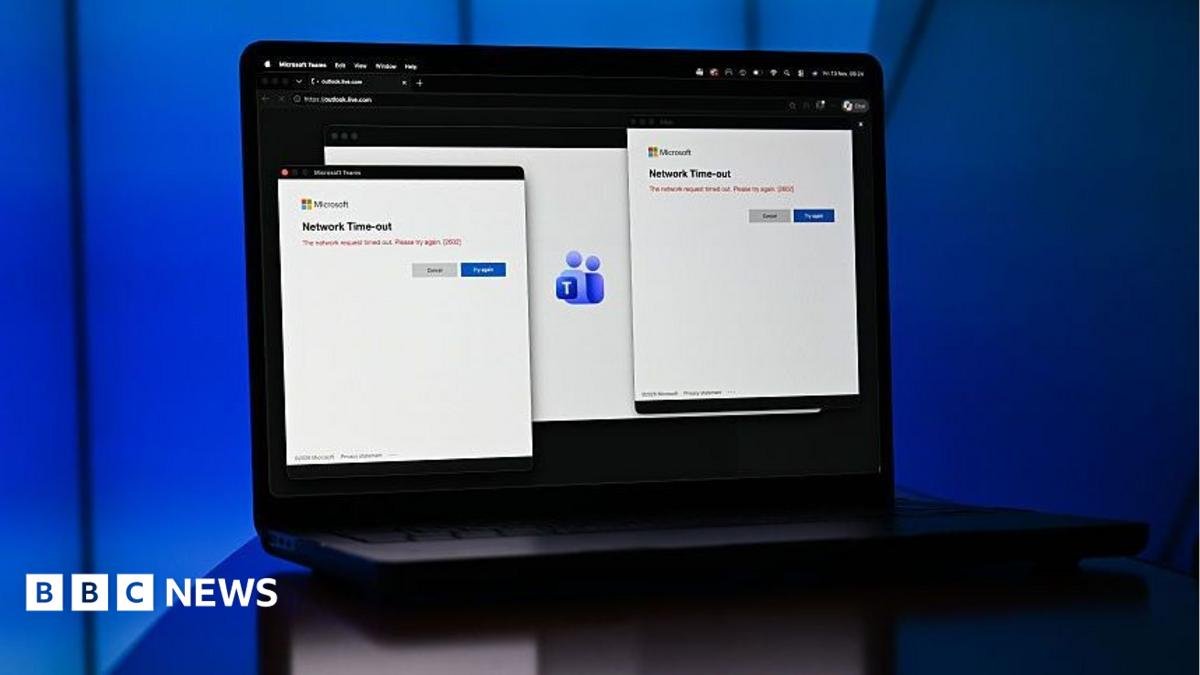
Microsoft has issued a public apology after a widespread service disruption that impacted millions of users worldwide, leaving essential tools like Outlook and Teams inaccessible for nearly 24 hours. The outage, which began on Thursday, affected more than 70 countries and disrupted operations for businesses, government agencies, and individuals alike.
Global Impact Felt Across Sectors
The outage had far-reaching consequences, affecting institutions ranging from the Japanese government and the Philippines Supreme Court to the Australian spy agency. In North America, trains, hospitals, and courts experienced disruptions. The UK's NHS reported some impact on GP services and hospitals, while schools and police forces also faced challenges. In Canada, the national rail network warned passengers of potential delays in email updates, and hospitals nationwide encountered email issues.
In the US, staff members from the House of Representatives told Politico that the outage set back an entire day of legislative work, as operations rely heavily on Microsoft Outlook. Singapore's government acknowledged impacts on some of its systems, and in India, many workers faced disruptions on Friday. Even the COP31 climate summit in Antalya, Turkey, saw advisers and officials frustrated by the inability to access Outlook.
Smaller businesses and individuals were not spared. Peter Pentz, a winemaker in South Africa, described his business as being brought to a "standstill." Communication with exporters halted, and critical production work was paused because the winery depends on these systems for daily operations. In the UK, Georgia from Staffordshire faced delays in completing her first house purchase after an eight-month wait. "The solicitor mentioned there may be a delay due to not being able to contact other agencies," she said. "We're not the only one completing today; there are hundreds of houses, and for them to ring everyone in time is unfeasible."
Technical Glitch, Not Cyberattack
Microsoft attributed the outage to a technical issue introduced during a "network capacity upgrade," ruling out any connection to cyberattacks or artificial intelligence agents. The company first acknowledged the problem at 17:54 GMT on Thursday, when users in the Americas reported being unable to access Exchange Online mailboxes. Shortly after, Microsoft warned that the disruption could affect Microsoft 365 globally.
By Friday afternoon, services were broadly recovering, with Microsoft reporting "encouraging progress" and email queues nearing normal levels. The tech giant said it restored services gradually due to the scale of the problem and to ensure stability once systems were back online. "We are deeply sorry for the disruption this incident has caused our customers and partners," a Microsoft spokesperson said. "We know the trust they place in our services and take that responsibility extremely seriously." A full post-incident report will be released after a review is completed.
Experts Warn of Overreliance on Big Tech
Experts described the event as a "stark reminder" of how heavily businesses and vital services rely on a small group of big tech providers. Rob Demain, chief executive of cybersecurity firm e2e-assure, said, "The global Microsoft outage is a stark reminder of how heavily we rely on a handful of big tech providers." Matt Saunders, field chief technology officer at tech consultancy Adaptavist, noted the difficulty of mitigating such risks. "Classic IT disaster planning strategies suggest using a second service for resilience, but in practice, it's almost impossible for a business to function without tools such as Microsoft," he said. "In the wake of this outage, organisations must have a plan in place for how to work without such tools, for when incidents like this occur."
As services continue to recover, the incident underscores the vulnerability of global infrastructure to technical failures at major tech companies. With over 430 million people using the affected products worldwide, the outage serves as a cautionary tale about the concentration of critical services in the hands of a few providers.