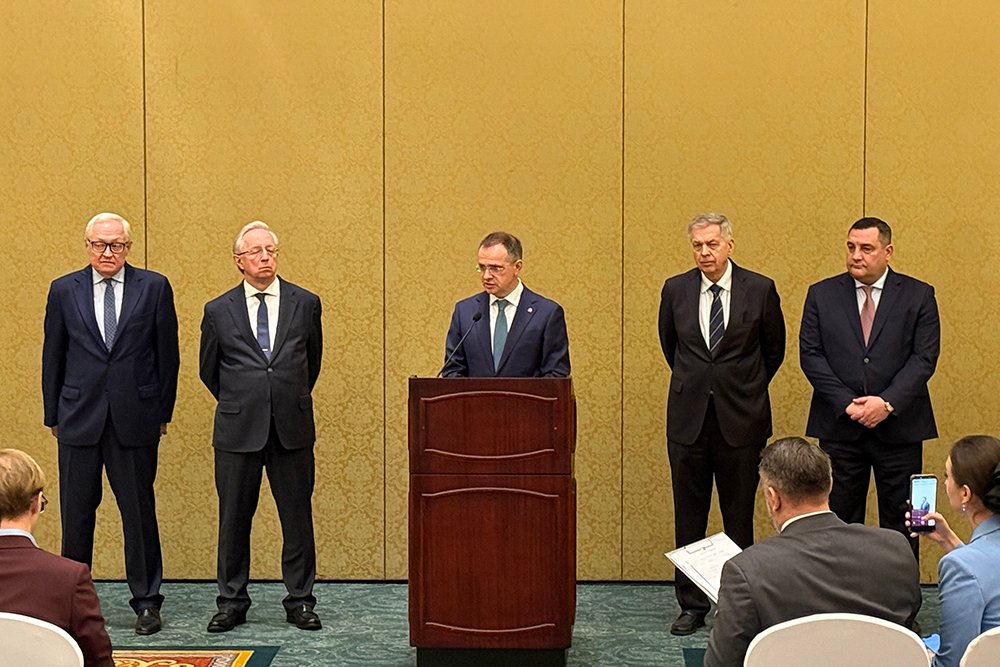
US envoys Steve Witkoff and Jared Kushner are set to hold separate meetings with Russian President Vladimir Putin and Ukrainian President Volodymyr Zelensky on Thursday, following two days of talks in Abu Dhabi aimed at ending the war in Ukraine. The discussions, the first since February when US military action in Iran disrupted diplomacy, yielded a major prisoner exchange, described by Kushner as the "biggest" ever, though no specific numbers were released.
Diplomatic Push
Witkoff and Kushner will first travel to Moscow to meet Putin, then fly to Dublin where Zelensky is attending European meetings, to brief the Ukrainian leader. Kushner said the meeting with Putin would "go over what was discussed today and try to make more progress on some of the issues that we discussed because we see some openings and some opportunities." With Zelensky, the pair will "further explore some of the ideas that we came up with here today."
Despite the positive tone, deep divisions remain, particularly over Europe's role in future negotiations. Ukraine's top negotiator, Rustem Umerov, acknowledged that "significant differences remain" and that there was "still a lot of difficult work ahead, but there are opportunities to continue the negotiation process." Russia's delegation chief, Vladimir Medinsky, told reporters that the "discussion will certainly continue" but questioned including Europe in the talks.
Europe's Role in Question
Medinsky later told Russian TV that Moscow's aim is a "new, modern Yalta and Potsdam," referring to the 1945 conferences where Western leaders divided Europe with the USSR's Joseph Stalin. Ukraine has warned against such a scenario and has called for greater involvement from its key European backers. Kushner said seeking ways to "get the Europeans added to the format" would be on the agenda with Putin. Officials from Britain, France, Germany, and Italy, as well as NATO and the European Union, traveled to Abu Dhabi for meetings on the sidelines.
Humanitarian Toll
Five years of war have taken a devastating toll. Hundreds of thousands of people have been killed since Russia's invasion in February 2022, making it Europe's worst conflict since World War II. Millions more have fled the fighting in eastern and southern Ukraine, where relentless aerial bombardments have destroyed large swathes of land. Russia is demanding that Ukraine withdraw from parts of eastern Ukraine it still controls and wants a sweeping deal on "Europe's security architecture" as part of any agreement to halt the war.
As the envoys shuttle between capitals, the world watches to see whether these talks can pave the way for a lasting peace or merely mark another pause in a conflict that has reshaped the global order.