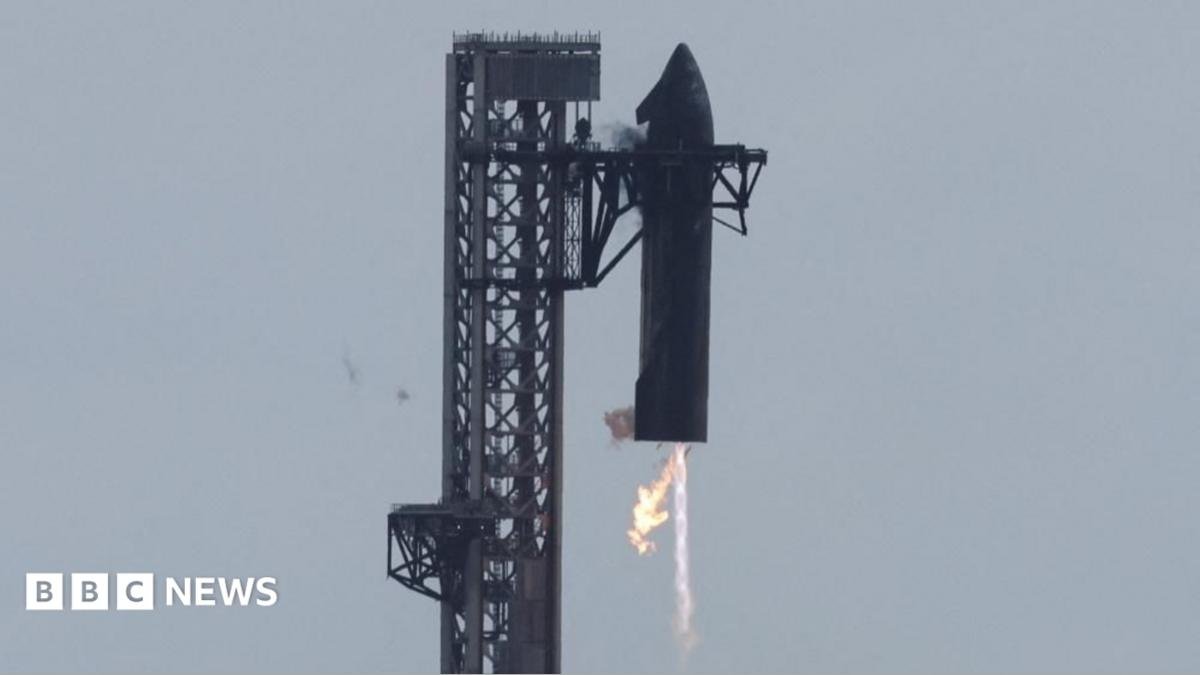
In a groundbreaking achievement that pushes the boundaries of space exploration, SpaceX has successfully caught the upper stage of its Starship rocket as it returned to Earth for the first time. The dramatic event unfolded at the company's launch site in Texas, where crowds erupted in cheers and a commentator exclaimed, "Can you believe it?" as the massive spacecraft was snagged mid-air by the launch tower's mechanical arms, affectionately known as "chopsticks."
A Milestone for Reusability
The catch marks a significant step forward in SpaceX's quest to create fully reusable rockets, a key goal for reducing the cost of space travel. The company had initially planned to catch both the lower booster and the upper stage (referred to as the Ship) using the chopstick arms. However, the booster catch was aborted shortly after Friday's launch, and the booster was diverted to the ocean, where it burst into flames just above the sea. Despite this setback, the successful capture of the Ship on Saturday at around 15:27 local time (21:27 GMT) demonstrates the viability of the novel recovery method.
Technical Details and Challenges
The Starship system is designed to be the world's most powerful launch vehicle, capable of carrying humans and cargo to the Moon, Mars, and beyond. The upper stage, which separated from the booster and continued into space, executed a controlled descent back to the launch site. The chopstick arms, mounted on the launch tower, precisely closed around the spacecraft as it hovered, securing it for potential reuse. This approach eliminates the need for landing legs and allows for rapid turnaround between flights.
SpaceX CEO Elon Musk has long championed rapid reusability as the key to making life multiplanetary. The successful catch is a critical validation of the concept, though challenges remain. The booster's failed catch highlights the complexities of the system, and the company will need to refine the process to achieve consistent recoveries.
Implications for the Future
This achievement comes as SpaceX continues to test and iterate on the Starship prototype. The company has faced several setbacks, including explosive failures during early test flights, but has steadily progressed. The successful catch of the upper stage is a major confidence boost for the program, which is also contracted by NASA to land astronauts on the Moon as part of the Artemis missions.
Industry experts view this as a pivotal moment. "Catching the upper stage is a remarkable feat of engineering," said Dr. Sarah Thompson, a space policy analyst. "It demonstrates SpaceX's innovative approach and brings us closer to a future where rockets are as reusable as airplanes."
As SpaceX continues to push the envelope, the world watches with bated breath. The company's relentless pursuit of reusability could revolutionize space access, making it more affordable and frequent. For now, the team in Texas is celebrating a hard-won victory, one that brings the dream of a sustainable spacefaring civilization one step closer to reality.