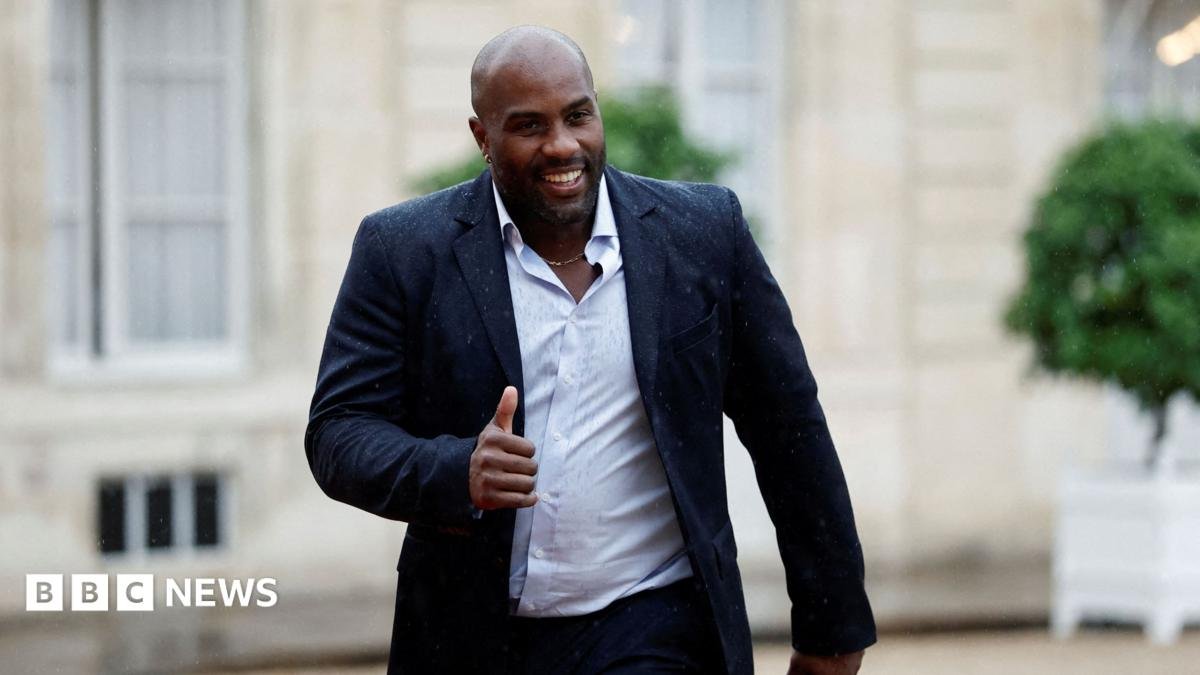
In a surprising turn of events, France's most celebrated judoka, Teddy Riner, has announced his candidacy for the 2027 presidential election, sending ripples through a political landscape already marked by uncertainty and fragmentation.
Riner, a five-time Olympic champion and 11-time world champion, is widely regarded as one of the nation's most beloved figures. His entry into politics, announced via a social media broadcast that garnered over 28 million views, has immediately positioned him as a potential disruptor in a race that many predict will be a showdown between the far-right and the hard-left.
A Popular Figure with No Political Baggage
At 37, Riner boasts no political experience, no party affiliation, and, as yet, no detailed manifesto. His campaign slogan, "La France qu'on aime" (The France we love), and his call to "unite the country" resonate with a electorate weary of traditional politics. In a recent Ifop poll, 22% of respondents said they could vote for him, underscoring his appeal.
Political analysts, including Le Figaro's Guillaume Tabard, caution against underestimating Riner. "Anyone who thinks that being out of the political in-crowd disqualifies Riner would be very wrong," Tabard noted. However, he added that Riner would also be mistaken to believe that being an outsider is sufficient.
The Centrist Dilemma
Riner's candidacy complicates an already crowded centrist field. With figures like former prime ministers Edouard Philippe and Gabriel Attal struggling to gain traction, and a dozen candidates vying for the center-right to center-left space, Riner's entry could further dilute the vote. This scenario potentially benefits far-right leader Marine Le Pen and hard-left candidate Jean-Luc Mélenchon, who are currently leading in the polls.
Interestingly, both Mélenchon and President Emmanuel Macron have welcomed Riner's candidacy, albeit for different reasons. Mélenchon sees Riner's "neither left nor right" stance as effectively aligning with the right, while Macron's approval may stem from his strained relations with his former prime ministers.
Challenges Ahead
Riner's campaign will need to address substantive issues, from pension reform to public debt and the rising cost of living. His initial rhetoric has focused on themes of national unity and economic pragmatism, but he has yet to outline specific policies. As a Black athlete of Caribbean descent, Riner is also expected to speak forcefully against racism, positioning himself against extremism.
While his popularity is undeniable, translating athletic success into political mandate is a formidable task. As Riner himself acknowledged, politics is far more vicious than judo. The coming months will reveal whether he can transition from a symbol of sporting excellence to a credible political leader.
For now, France watches with bated breath as a judo champion attempts to throw his weight into the political arena, potentially reshaping the nation's future.