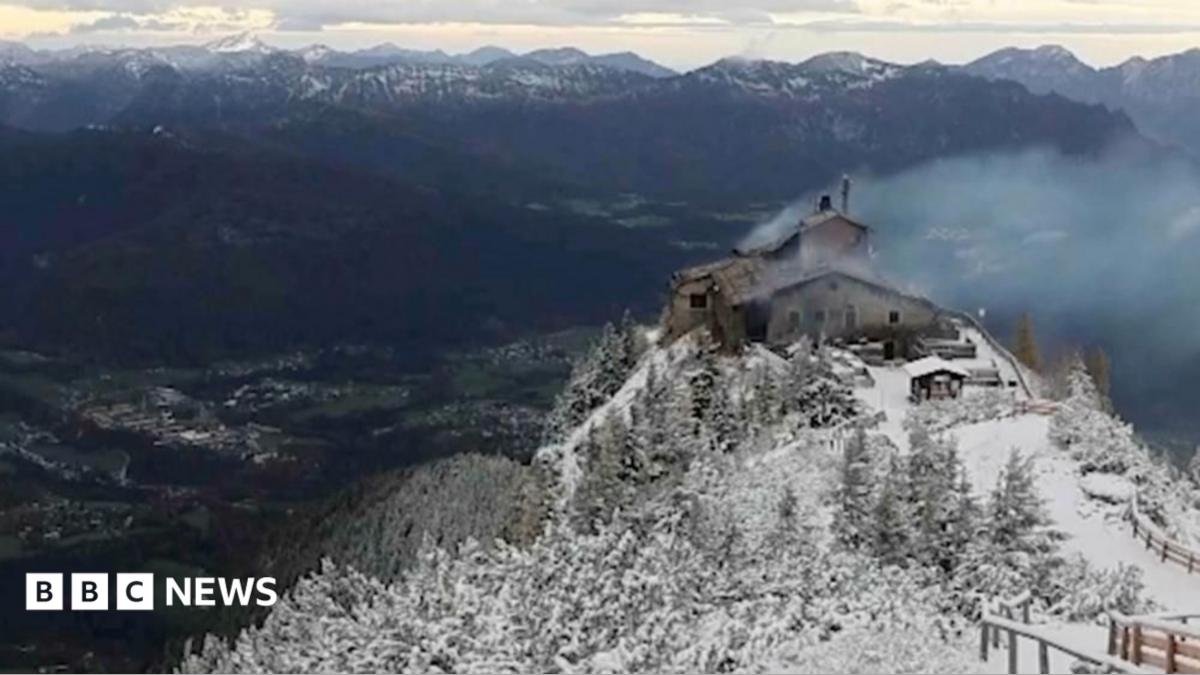
The Eagle's Nest, a mountaintop retreat in the Bavarian Alps built by the Nazis in 1938 and frequented by Adolf Hitler, was severely damaged by fire last month in what authorities suspect was arson. The blaze has reignited a long-simmering debate in Germany over how to handle sites tied to the Nazi era.
A Controversial Landmark
Known in German as the Kehlsteinhaus, the building sits at an elevation of 1,834 meters (6,017 feet) above sea level, offering sweeping views of the Alps and the town of Berchtesgaden below. After World War II, it was classified as a historical monument, and for decades it operated as a restaurant and tourist attraction, drawing tens of thousands of visitors each season. The site also housed a photo exhibit on its history, and nearby, the Obersalzberg Documentation Centre opened in the 1990s to confront the crimes of the Nazi past.
The fire, which broke out on the evening of 23 October, largely destroyed the Eagle's Nest, though the documentation center survived. A 33-year-old man with a history of mental illness has been detained in a secure psychiatric hospital on suspicion of arson. Authorities have not commented on a possible motive.
To Rebuild or Let It Fade?
The destruction has prompted conflicting views on what should happen next. Some argue that the site should be left in ruins and allowed to return to nature, erasing any physical reminder of its Nazi association. Among them is Professor Sir Richard J. Evans, a historian of Nazi Germany at the University of Cambridge, who said: "It's been torched now. It's been destroyed. I think they should just clear away the rubble and leave the mountain as it should be in its natural state." He pointed to other Nazi sites that were demolished or repurposed, such as Hitler's bunker in Berlin, which was filled with concrete and covered by a children's playground.
Others, however, warn that simply removing the site could turn it into a pilgrimage destination for neo-Nazis. Sven Keller, head of the Obersalzberg Documentation Centre, noted that when Hitler's nearby Berghof was demolished in the 1950s, it did not erase the site from the mental maps of extremists. "We have quite some experience at Obersalzberg with what happens if we clear those sites," he told the BBC. "In our experience, this does not remove such sites from the mental maps of people."
Political and Historical Considerations
Bavaria's interior minister, Joachim Herrmann, and its arts minister, Markus Blume, have both spoken in favor of rebuilding the Kehlsteinhaus. "We can hardly leave a ruin standing there," Herrmann said. However, Blume has made clear that any reconstruction should not cost the taxpayer anything. Herrmann added that they would seek a sensible solution in consultation with historians, given the building's complex historical context.
Professor Isabel Heinemann, a contemporary historian at Ludwig-Maximilians-Universität in Munich, believes a full reconstruction would be inappropriate. "I rather think we can document the state left by the fire and also document the historical remains of the Kehlsteinhaus, and then reconstruct parts in a modern design, to make clear the different layers of time that can be seen in this building," she told the BBC. She emphasized Germany's "everlasting responsibility to communicate, to deal with our Nazi past," but warned that rebuilding the site completely would mean putting "highly ideologised or highly ideological architecture" back in place.
A Broader Reckoning
The debate over the Eagle's Nest is part of a wider struggle in Germany and Austria over how to handle the legacy of Nazi-era buildings and sites. The rise of the far-right AfD in Germany and the Freedom Party in Austria has added urgency to discussions about Erinnerungskultur, or culture of remembrance. Recent controversies include a decision by AfD and conservative CDU councillors in a Saxon town to ban "stumbling stones" memorials to Nazi victims, and the opening of a police station in the house where Hitler was born in Braunau am Inn, Austria, to prevent neo-Nazi pilgrimages.
As one resident of Braunau am Inn put it, the challenge lies in finding a delicate balance between how much to remember and how much to forget. The future of the Eagle's Nest will be a test of that balance.