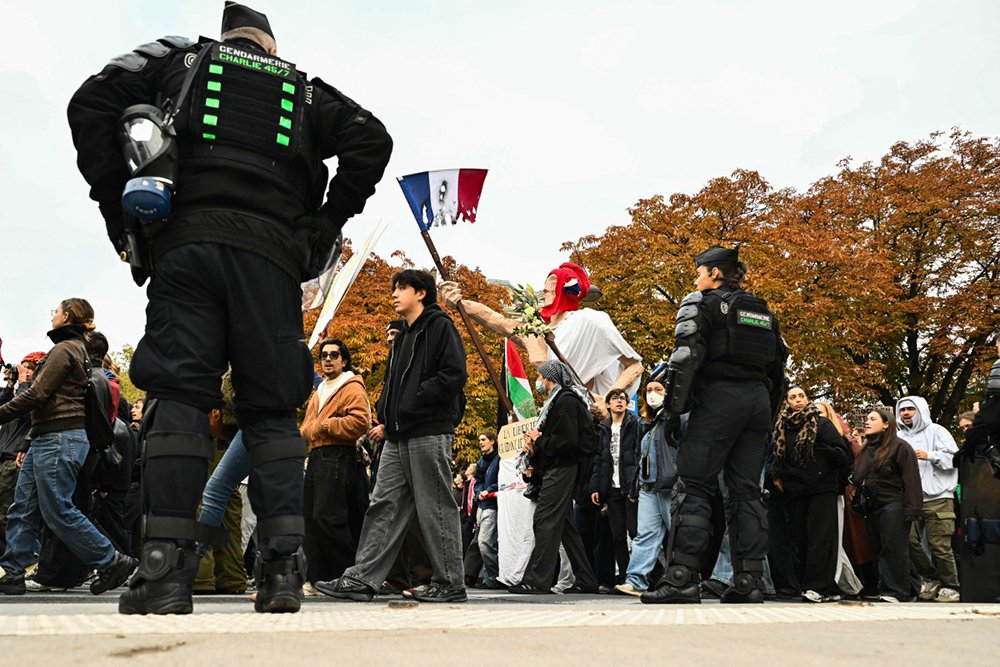
France is preparing for another day of widespread demonstrations on Saturday, with tens of thousands of people expected to take to the streets in a fresh expression of public frustration with the government. In Paris, police have put stringent security measures in place to stop an unauthorised gathering near the Élysée Palace, the official residence of the president.
A Fourth Consecutive Weekend of Unrest
The planned marches mark the fourth straight weekend of protests, a movement that has gathered pace as the country moves closer to presidential elections scheduled in five months. The far right views the upcoming vote as its strongest opportunity yet to capture power.
Authorities estimate that as many as 170,000 people could demonstrate nationwide, with around 60,000 expected in the capital alone. The mobilisation follows large-scale union-led protests and strikes two days earlier, on November 5, which underscored growing discontent over the cost of living and inequality.
Security Forces on High Alert
Roughly 70,000 members of the security forces have been deployed across the country on Saturday. Officials say they are prepared to intervene swiftly, mindful of the violent clashes that erupted during protests on October 17, which escalated into some of the most serious riots France has witnessed in recent years.
Unions have organised a march along a well-established route, starting at the Place de la République in central Paris and ending at the Place de la Nation in the east of the city. However, the Yellow Vests movement, whose demonstrations rattled President Emmanuel Macron during the early years of his presidency nearly a decade ago, has called for a separate rally at the Place de la Concorde. That location is just a short distance from the Élysée Palace and the lower house of parliament, heightening security concerns.
Nationwide Discontent
The protests are not confined to the capital. Demonstrations are also taking place in cities such as Lille in the north and Montpellier in the south, drawing together the Yellow Vests, labour unions, and high school and university students. The broad coalition reflects widespread anxiety over the rising cost of living and deepening social inequality.
The government has sought to ease tensions. The prime minister has announced a social dialogue meeting scheduled for November 9 with trade unions and employers' organisations, in what appears to be an effort to open a channel for negotiation amid the mounting pressure.
Still, the scale of the planned demonstrations suggests that public anger remains intense, and the coming weekend could prove another significant test for the authorities as they balance the right to protest against the need to maintain public order.