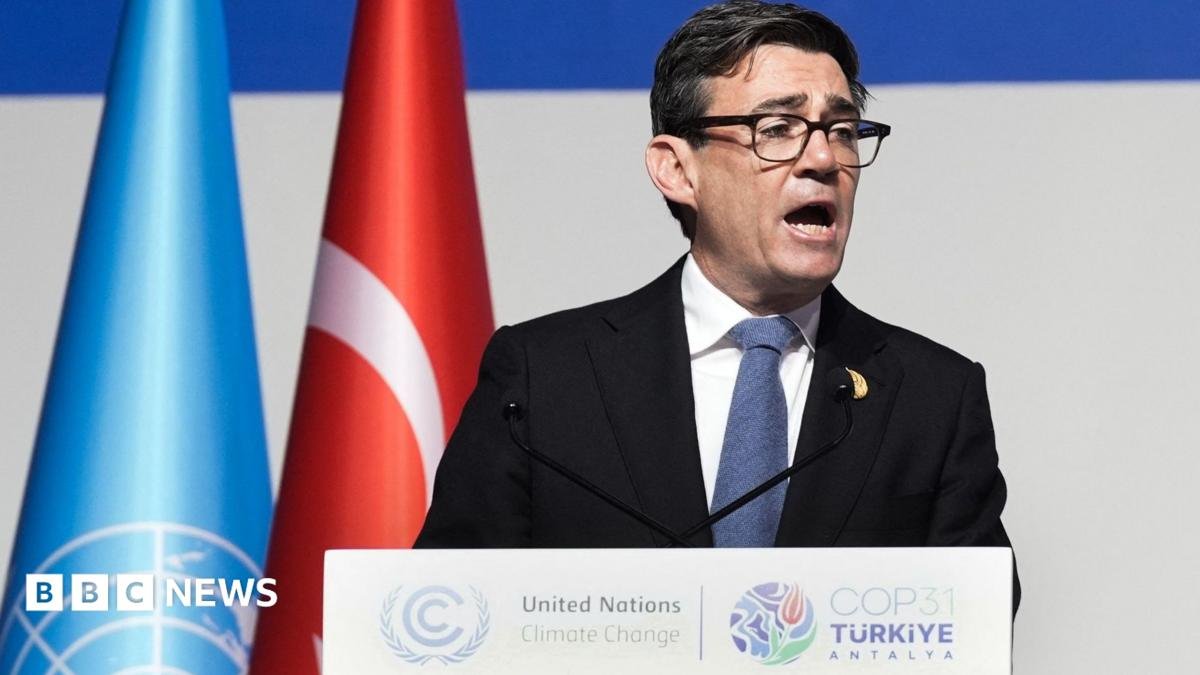
Prime Minister Andy Burnham has declared that the global consensus on climate science and action has "gone," but he used his address at the COP31 summit in Turkey to pledge a "new era of British leadership" on the issue. Burnham was the only G7 leader to attend the conference, underscoring a dwindling commitment among major economies to the UN climate process.
A Stark Warning
In his speech on Thursday, Burnham opened by recalling the extreme heat experienced in the UK this summer, which he described as "not normal." The Met Office confirmed it was the hottest summer on record, made 130 times more likely by climate change. The impacts were severe: hundreds of schools closed, cereal harvests fell by 11%, and ambulance services received calls surpassing levels seen during the Covid-19 pandemic.
Highlighting the threat to public health and homes, Burnham announced the creation of the UK's, and the world's, first climate security envoy, Dame Madeleine Alessandri. A former head of the Joint Intelligence Committee, Alessandri said: "Climate change and nature loss are increasingly shaping the security environment in which the UK operates," adding that this was "placing additional pressure on resources, economies and communities around the world." Her appointment is seen as a strong signal of the UK's priorities as it prepares to assume the G20 presidency next year.
Praise and Criticism
Professor Lord Nicholas Stern, who two decades ago warned that unchecked climate change could cost up to 20% of global GDP, welcomed the Prime Minister's remarks. "The Prime Minister was right to identify climate change as a threat to security around the world, and the importance of investments in clean electricity generation as the best way of protecting households and businesses from the high prices and volatile markets for fossil fuels," Stern said.
However, environmental campaigners accused Burnham of double standards. "The Prime Minister simply cannot call for clean power across the world while saying yes to more fossil fuels in the UK," said Beth John, climate adviser at Oxfam. Recent government policies have raised concerns, including reduced support for heat pumps, approval of the Jackdaw gas field, and backing for Heathrow Airport's expansion.
Commitment to Net Zero
Burnham reaffirmed his government's commitment to achieving net zero by 2050 while also reducing energy bills. He stressed the need to cut "dependence on fossil fuels" and increase electrification, the share of energy needs met from renewable electricity. Turkey, co-host of COP31, aims for countries to commit to meeting 35% of their energy supply from electricity by 2035, up from about a fifth currently.
The Prime Minister acknowledged the fractured global landscape, noting that the consensus on science and climate has disappeared and that the world is now on track to reach 1.5 degrees of warming. His words echoed those of his predecessor, Sir Keir Starmer, from the previous year.
King Charles III, who did not attend, sent a message urging collective action: "Our children and grandchildren will not judge us by the promises we made, but by what we chose to do."
As the summit continues, leaders from island nations such as Tonga, Tuvalu, and the Solomon Islands are expected to speak, highlighting the immediate threats they face from rising sea levels. The World Meteorological Organisation reported that global mean sea level is at its highest since records began, a stark reminder of the challenges ahead.